Best Age to Read Little House on the Prairie
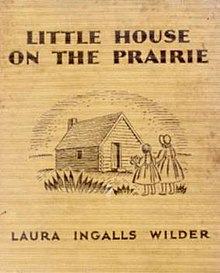 Front hardcover, showtime edition of the about frequently adapted volume (1935) | |
| |
| Author | Laura Ingalls Wilder |
|---|---|
| Country | Usa |
| Language | English |
| Genre | Fiction |
| Publisher | Harper & Brothers |
| Published | 1932–1943, 1971 |
| No. of books | 9 |
The "Little House" Books is a serial of American children's novels written by Laura Ingalls Wilder, based on her childhood and boyhood in the American Midwest (Wisconsin, Kansas, Minnesota, Southward Dakota, and Missouri) between 1870 and 1894.[1] Viii of the novels were completed past Wilder, and published by Harper & Brothers. The appellation "Little Firm" books comes from the first and third novels in the series of viii published in her lifetime. The second novel was well-nigh her hubby'due south childhood. The beginning draft of a 9th novel was published posthumously in 1971 and is usually included in the series.[two]
The Lilliputian Business firm books have been adapted for phase or screen more once, nearly successfully equally the American television series Piffling Firm on the Prairie, which ran from 1974 to 1983.[3] As well every bit an anime and many spin-off books, in that location are cookbooks and diverse other licensed products representative of the books.[4]
A 10th book, the non-fiction On the Style Abode, is Laura Ingalls Wilder's diary of the years subsequently 1894, when she, her married man and their daughter moved from De Smet, South Dakota to Mansfield, Missouri, where they settled permanently. It was published in 1962 and includes commentary by her daughter, Rose Wilder Lane.
History [edit]
Publishing [edit]
The start book of the Little House series, Little House in the Big Forest, was published in 1932.[five] This kickoff book did well when it was first published.[6] The Little Firm books were reissued past Ursula Nordstrom to be illustrated by Garth Williams.[7]
Before writing the Little Firm series Laura Ingalls Wilder was a columnist in a farm journal.[half-dozen] Her daughter, Rose Wilder Lane, was the motivator backside Wilder's writing and publishing of the beginning volume.[5] Since the starting time book, there have been effectually 60 million Picayune House books sold.[5] In that location are 9 books that fall nether the Little House books umbrella.[8]
Rose Wilder Lane had a heavy paw in the editing of the books, though Laura Ingalls Wilder's vox is still strong.[6] Lane'southward level of influence is disputed, but views that align with hers are very visible inside the books.[5] Regardless, Rose Wilder Lane was a large role in the publishing and class of the books. Lane as well had a hand in giving the rights to Roger Lea MacBride, who then led to the cosmos of the tv testify entitled Trivial House on the Prairie.[5]
Time ranks the Piddling House series every bit 22 out of 100 of the "100 Best Young Developed Books of All Time."[nine] They are considered classics of American children's literature and remain widely read. In a 2012 survey published past School Library Journal, a monthly with primarily U.Southward. audience, Little Firm in the Large Woods was ranked number 19 amongst all-time all-time children'southward novels, and two of its sequels were ranked amid the top 100.[10] V of the Little Business firm book have been Laurels Books for the Newbery Medal. In 1938, On the Banks of Plum Creek, was an Award Book; in 1940 By the Shores of Silvery Lake was also. Afterwards in 1941, The Long Winter, became an Honor Book, and the two after Accolade Books were The Piddling Boondocks on the Prairie, in 1942, and Those Happy Golden Years in 1944.[11] In addition to this, the American Library Clan stated that The Long Winter, the seventh book in the series, was a "resource for pedagogy about pioneer history."[12]
Delineation of minorities [edit]
The Fiddling House books include people from indigenous minorities, including a heroic blackness doctor who saves the protagonist's family. Yet, in that location take been criticisms of the Little House books considering of portrayals of Native Americans.[13] Much of the criticism relates to some of the characters expressing negative stereotypes equally well equally a view of them equally less than man.[14] There has as well been criticism of the ignorance nowadays in the books of the illegality of the Ingalls' occupation of state they did non have the right to occupy.[fourteen]
An incident concerning Wilder'south depiction of Native Americans occurred in 1998, when an eight-yr-onetime girl read Fiddling House on the Prairie in her elementary school class. In the volume, a minor character says "The but skilful Indian is a dead Indian," to which Pa replies that "he didn't know virtually that. He figured that Indians would be as peacable as anybody else if they were let alone." The girl's mother, Waziyatawin Angela Cavender Wilson, a member of the Wahpetunwan Dakota nation, challenged the school on its employ of the book in the classroom.[15] This was one of many statements and actions that prompted the American Library Association to investigate and ultimately change the name of the Wilder Award to the Children'south Literature Legacy Award.[fifteen] [16] This honor is given to books that take made a big touch on on children'southward literature in America.[17]
Accuracy to history [edit]
Laura Ingalls Wilder's work is autobiographical fiction and Wilder employed creative licence, including creating composite characters based on multiple real individuals[14] and presenting a subjective view of her family'southward experiences.[eighteen] It has been criticized regarding the history of the regime'due south involvement in homesteading,[eighteen] and its effect upon Native American people,[14] including her family's occupation of country which was all the same recognized past the United states of america government equally the Osage Nation's territory.[14]
Connections with politics [edit]
While Laura Ingalls Wilder wrote the Little House books, it was Rose Wilder Lane who edited them and it was Lane who had the rights after Wilder's death. Rose was an "outspoken antigovernment polemicist and is called one of the grandmothers of the libertarian movement."[5] Lane'due south views were supported past her mother.[6] Despite her female parent's back up of her political views, Lane went confronting her mother and what was written in her will by leaving the rights of the Little House books to Roger Lea MacBride after her ain death.[six] Roger Lea MacBride has strong connections to politics, beingness a in one case libertarian presidential candidate, and a member of the Republican Liberty Caucus.[5] He gained the rights to the books not only from Lane's will but likewise through a legal battle with the library that Wilder wrote in her will should proceeds the rights after Lane's expiry.[v] Information technology was MacBride who immune the telly bear witness to exist made and who talked well-nigh Laura'southward books, and through the rights he made a great deal of money.[5]
Another political issue raised past the practice of homesteading as described in the Petty House books is John Locke's Labor Theory of Property, which is the idea that if someone improves the land with their ain labor that they and so have rights to that land.[xix]
Delineation of the United States Regime [edit]
Anti-governmental political views, such every bit those held past Rose Wilder Lane, have been attributed to the Little Business firm books. In her article, "Little House on the Prairie and the Truth Near the American West", historian Patricia Nelson Limerick connects Wilder'southward apparent and Lane'southward outright distaste for the government as a mode to blame the government for their father's failure at homesteading.[half-dozen] The books prove the Wilder family unit to exist entrepreneurs and testify a form of hero worship of Laura Ingalls Wilder'south parents.[18] In "Little House on the Prairie and the Myth of Self Reliance", Julie Tharp and Jeff Kleiman say that the thought of the settlers' cocky-reliance, which they consider to be a myth, has contributed to bourgeois rhetoric, and that the Piffling House books are full of this myth.[18]
Books [edit]
- Piffling House in the Large Wood (1932)
- Farmer Boy (1933)
- Fiddling Business firm on the Prairie (1935)
- On the Banks of Plum Creek (1937)
- By the Shores of Silverish Lake (1939)
- The Long Wintertime (1940)
- Picayune Town on the Prairie (1941)
- These Happy Golden Years (1943)
- The Outset Four Years (1971)
Iv serial of books expand the Little Business firm series to include five generations of Laura Ingalls Wilder's family unit. The "Martha Years" and "Charlotte Years" series, by Melissa Wiley, are fictionalized tales of Laura's great-grandmother in Scotland in the late 18th century and grandmother in early 19th century Massachusetts.[20] The "Caroline Years" series narrates Wilder's mother, Caroline Quiner's, babyhood in Wisconsin.[21] The Rose Years (originally known every bit the "Rocky Ridge Years") serial follows Rose Wilder Lane from childhood in Missouri to early adulthood in San Francisco. It was written by her surrogate grandson Roger MacBride.[22]
Two volumes of Wilder'due south messages and diaries have also been issued under the Little Business firm imprint: On The Way Habitation and West From Home, published by Harper Collins in 1962 and 1974 respectively.[23] [24]
The historical fiction books "Little House on The Prairie" have prequel stories that go back in history iii generations. Written subsequently the originals, the prequel stories are based on historical records including birth, wedlock and decease certificates, family messages and diaries and other public documentation of actual places and events much like the "Niggling House" books. The 3 prequel series are "The Martha Years" (cracking-grandmohter), "The Charlotte Years" (grandmother) and "The Caroline Years" (mother). Martha Morse Tucker was Laura Ingalls Wilder's great-grandmother. She was born in Scotland and moved to Boston, MA in the 1700'southward. One of her children was Charlotte -- Laura's grandmother. Charlotte's life story is told in the books series "The Charlotte Years." Charlotte was Laura Ingalls Wilder'southward grandmother -- the mother of Caroline who was Laura's mother, who also has a series nigh her life. The stories also go on into the future after the "Picayune Firm" series with books inspired by Laura Ingalls Wilder's daughter, Rose. Besides considered historical fiction with documentation almost Laura's afterward years and Rose's life in the San Francisco Bay area, taken together with the prequels, readers have admission to generations of historical fiction.
The books in the prequels are:
Books about Martha Morse:
-Little Business firm in the Highlands
-The Far Side of the Loch
-Downwardly to the Bonny Glen
-Beyond the Heather hills
Charlotte Tucker books:
-Little House by Boston Bay
-On Tide Manufacturing plant Lane
-The Road from Roxbury
-Across the Puddingstone Dam
Books about Caroline Quiner Ingalls:
-Piddling Business firm in Brookfield
-Piddling Town at the Crossroads
-Little Immigration in the forest
-On Top of Agree Hill
-Across the Rolling River
-Petty City past the Lake
-A Little House of Their Ain
The Rose Years books:
-Little House on Rocky Ridge
-Little Farm in the Ozarks
-In the Land of the Big Apples
-On the Other Side of the Loma
-Trivial Town in the Ozarks
-New Dawn on Rocky Ridge
-On the Banks of the Bayou
-Available Girl
Petty House in the Large Woods [edit]

Front hardcover, first ed. of the first vol. (1932)
Lilliputian House in the Large Woods was published in 1932. Written by Laura Ingalls Wilder, the book is autobiographical, though some parts of the story were embellished or changed to appeal more to an audition, such as Laura's age. In the book, Laura herself turns five years erstwhile, when the real-life author had only been three during the events of the volume. Co-ordinate to a letter from her daughter, Rose, to biographer William Anderson, the publisher had Laura change her age in the book considering information technology seemed unrealistic for a three-twelvemonth-former to accept specific memories such as she wrote about.[25] The story of Little Firm in the Big Woods, revolves effectually the life of the Ingalls family. The family includes mother Caroline Ingalls, father Charles Ingalls, elder daughter Mary Amelia Ingalls, and younger girl (and protagonist), Laura Ingalls Wilder.[26] Also in the story, though not yet born historically, is Laura'southward baby sis Carrie.

The setting of this book is different from the rest of the series, as the story takes place in the Ingalls' small cabin in the state of Wisconsin, near a town called Pepin. Fiddling House in the Large Woods describes the homesteading skills Laura observed and began to do during her fifth year. The cousins come up for Christmas that year, and Laura receives a doll, which she names Charlotte. Later that winter, the family goes to Grandma Ingalls' domicile and has a "sugaring off," when they harvest sap and brand maple syrup. They render home with buckets of syrup, enough to concluding the yr. Laura remembered that sugaring off and the dance that followed for the residue of her life.[27]
The book besides describes other subcontract work duties and events, such as the birth of a calf; the availability of milk, butter and cheese; gardening; field work; hunting; gathering; and more. Everyday housework is also described in detail. When Pa went into the wood to hunt, he commonly came habitation with a deer and then smoked the meat for the coming wintertime. One mean solar day he noticed a bee tree and returned from hunting early to get the wash tub and milk pail to collect the beloved. When Pa returned dwelling house on winter evenings, Laura and Mary ever begged him to play his fiddle, only he was too tired from farm work to play during the summertime.[27] Afterward in the series, the family moved abroad from Wisconsin to a homestead in Kansas, as territory in the West was being given to settlers. After they moved on to Minnesota. This reflects the time period in the 1800'southward during which farmers and many others were migrating w into the American borderland.
Farmer Male child [edit]
Farmer Boy was published in 1933. It is the second Little Business firm book, although its story is unrelated to the first few books in the series. It features a unlike protagonist named Almanzo Wilder, who subsequently became Laura's husband. InFarmer Boy, Almanzo is featured from before his ninth birthday until after his tenth. Throughout the novel, Laura recounts the experiences and adventures of Almanzo in his belatedly babyhood and adolescence. Living in a successful farm in the land of New York in the belatedly 19th century, Almanzo endures hardships such as the long 1.v mi (2.iv km) walk to school with his older siblings. Through Farmer Male child, readers catch a glimpse of the daily routine of early on farmers, and learn well-nigh activities such as candle making, shearing sheep, threshing wheat, and even making donuts. The story also walks readers through Almanzo's favorite pastimes, which include sledding, berry picking, pond, and fishing.[28]
Little House on the Prairie [edit]
Little House on the Prairie, published in 1935, is the third volume in the Little Business firm series but only the second that features the Ingalls family; it continues directly the story of the inaugural novel, Little Firm in the Big Wood.
The book tells about the months the Ingalls family unit spent on the prairie of Kansas, effectually the town of Independence, Kansas. At the commencement of this story, Pa Ingalls decides to sell the house in the Big Woods of Wisconsin and motility the family, via covered carriage,to the Indian Territory almost Independence, Kansas, as in that location were widely circulating stories that the land (under Osage ownership) would exist opened to settlement by homesteaders imminently. So Laura, along with Pa and Ma, Mary, and babe Carrie, movement to Kansas. Along the way, Pa trades his 2 horses for two Western mustangs, which Laura and Mary name Pet and Patty.[29]
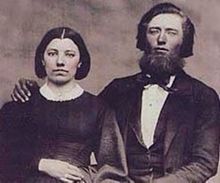
Caroline and Charles Ingalls
When the family reaches Indian Territory, they meet Mr. Edwards, who is extremely polite to Ma merely tells Laura and Mary that he is "a wildcat from Tennessee." Mr. Edwards is an excellent neighbor, who helps the Ingalls in every manner he can, get-go with helping Pa erect their firm. Pa builds a roof and a floor for their business firm and digs a well, and the family unit is finally settled.[29]
At their new dwelling, unlike their time in the Big Woods, the family meets difficulty and danger. The Ingalls family becomes terribly ill from a illness called at that time "fever 'n' ague" (fever with severe chills and shaking), which was after identified as malaria. Laura comments on the varied ways they believe to have acquired information technology, with "Ma" assertive it came from eating bad watermelon. Mrs. Scott, another neighbor, takes intendance of the family while they are sick. Around this fourth dimension, Mr. Edwards brings Laura and Mary their Christmas presents from Independence, and in the bound the Ingallses plant the beginnings of a pocket-size farm.[29]
Ma's fears nearly American Indians and Laura's observations at the time are assorted with Pa's liberal view of them, and all these views are shown adjacent with the older Laura's objective portrayal of the Osage tribe that lived on that state.[14]
At the end of this book, the family is told that the land must be vacated by settlers equally it is not legally open to settlement withal, and in 1870 Pa elects to get out the land and motion earlier the Ground forces forcibly requires him to abandon the land.[29]
On the Banks of Plum Creek [edit]
On the Banks of Plum Creek, published in 1937 and fourth in the serial, follows the Ingalls family as they move from Pepin, Wisconsin to Kansas to an area near Walnut Grove, Minnesota, and settle in a dugout "on the banks of Plum Creek (Redwood County, Minnesota)".[xxx]
Pa trades his horses Pet and Patty to the property owner (a man named Hanson) for the land and crops, simply later he gets 2 new horses as Christmas presents for the family, and Laura and her sister Mary name them "Sam" and "David". Pa soon builds a new, above-ground, wooden house for the family. During this story, Laura and Mary become to school in town for the first time, and they meet their instructor, Miss Eva Beadle. They also meet Nellie Oleson, who makes fun of Laura and Mary for being "land girls". Laura plays with her bulldog Jack when she is home, and she and Mary are invited to a party at the Olesons' habitation. Laura and Mary invite all the girls (including Nellie) to a party at their firm to reciprocate. The family presently goes through hard times when a plague of Rocky Mount locusts decimates their crops. The book ends with Pa returning safely to the house subsequently being unaccounted for during a astringent four-day blizzard.[31]
By the Shores of Silver Lake [edit]
Past the Shores of Silvery Lake was published in 1939 and is 5th in the series.
The story begins when the family is almost to go out Plum Creek shortly after the family has recovered from the scarlet fever which acquired Mary to go blind. The family welcomes a visit from Aunt Docia, whom they had not seen for several years. She suggests that Pa and Ma move due west to the apace developing Dakota Territory, where Pa could work in Uncle Henry'south railroad camp at very good wages for that era. Ma and Pa agree, since it will allow Pa to wait for a homestead while he works. The family has endured many hardships at Plum Creek, and Pa especially is anxious for a new start. Afterward selling his state and farm to neighbors, Pa goes ahead with the wagon and team. Mary is yet too weak to travel, and so the rest of the family follows afterward by train.[32]
The 24-hour interval Pa leaves, yet, their beloved bulldog Jack is institute dead, which saddens Laura greatly. In actuality, the dog upon whom Jack was based was no longer with the family at this signal, simply the author inserted his expiry here to serve every bit a transition betwixt her babyhood and her adolescence. Laura also begins to play a more than mature role in the family unit due to Mary's incomprehension. Pa instructs Laura to "be Mary's optics" and to help her in daily life as she learns to cope with her disability. Mary is strong and willing to learn.[32]
The family travels to Dakota Territory by railroad train. This is the children's kickoff railroad train trip and they are excited by the novelty of this new mode of transportation that allows them to travel in one hour the distance information technology would take a horse and carriage an entire twenty-four hour period to cover.[32]
With the family unit reunited and situated at the railroad camp, Laura meets her cousin Lena, and the two become good friends.[32]
As winter approaches and the railroad workers take down the cabins and head back east, the family wonders where they might stay for the winter. As luck would have it, the canton surveyor needs a house-sitter while he is back e for the winter, and Pa signs up. It is a winter of luxury for the Ingalls family as they are given all the provisions they need in the large, comfortable house. They spend a cozy wintertime with their new friends, Mr. and Mrs. Boast, and both families wait forward to starting their new claims in the spring.[32]
Only the "spring blitz" comes early on. The large mobilization of pioneers to the Dakotas in early on March prompts Pa to go out immediately on the few days' trip to the claims office. The girls are left alone to spend their days and nights boarding and feeding all the pioneers passing through. They charge 25 cents for dinner and boarding and beginning a savings account toward sending Mary to the School for the Blind in Vinton, Iowa.[32]
Pa successfully files his claim, with the assist of sometime friend Mr. Edwards. As the spring flowers bloom and the prairie comes alive with new settlers, the Ingalls family moves to their new piece of land and begins building what volition become their permanent dwelling house.[32]
The Long Winter [edit]
The Long Winter, published in 1940 and sixth in the series, covers the shortest fourth dimension bridge of the novels, only an eight-month period. The winter of 1880–1881 was a notably astringent wintertime in history, sometimes known as "The Snow Winter."[33] [34] [35]
The story begins in Dakota Territory at the Ingalls homestead in South Dakota on a hot September day in 1880 every bit Laura and her father ("Pa") are haying. Pa tells Laura that he knows the wintertime is going to exist hard because muskrats always build a house with thick walls before a hard winter, and this year they accept built the thickest walls he has ever seen. In mid October the Ingallses wake with an unusually early blizzard howling around their poorly insulated merits shanty. Soon after, Pa receives some other warning from an unexpected source: a dignified old Native American human comes to the general store in town to warn the white settlers that there will be seven months of blizzards. Impressed, Pa decides to move the family into boondocks for the wintertime.[36]
Laura attends schoolhouse with her younger sister Carrie until the conditions becomes too severe to permit them to walk to and from the school building. Blizzard after blizzard sweeps through the boondocks over the next few months. Food and fuel become deficient and expensive, as the town depends on the trains to bring supplies just the frequent blizzards prevent the trains from getting through. Eventually, the railroad company suspends all efforts to dig out the railroad train, stranding the town. For weeks, the Ingallses subsist on potatoes and fibroid dark-brown bread, using twisted hay for fuel. As even this meager food runs out, Laura'due south future married man Almanzo Wilder and his friend Cap Garland take a chance their lives to bring wheat to the starving townspeople – plenty to last the residual of the winter.[36]
Laura'due south age in this volume is authentic. (In 1880, she would have been 13, every bit she states in the first chapter.) However, Almanzo Wilder's age is misrepresented in this book. Much is made of the fact that he is 19 pretending to be 21 in guild to illegally obtain a homestead merits from the Usa government. But in 1880, his truthful age would have been 23. Scholar Ann Romines has suggested that Laura fabricated Almanzo younger because it was felt that more modern audiences would be scandalized by the great difference in their ages in light of their young spousal relationship.[37]
As predicted, the blizzards go along for seven months. Finally, the trains brainstorm running once again, bringing the Ingallses a Christmas butt full of good things, including a turkey. In the last chapter, they sit downwardly to enjoy their Christmas dinner in May.[36]
Niggling Town on the Prairie [edit]
Little Town on the Prairie, published in 1941 is seventh in the series.
The story begins equally Laura accepts her first chore performing sewing work in order to earn money for Mary to go to a college for the blind in Iowa. Laura'due south hard piece of work comes to an stop by summertime when she is permit become, and the family begins planning to raise cash crops to pay for Mary's higher. After the crops are destroyed by blackbirds, Pa sells a dogie to earn the rest of the money needed. When Ma and Pa escort Mary to the higher, Laura, Carrie, and Grace are left lone for a week. In order to stave off the loneliness stemming from Mary'due south departure, Laura, Carrie, and Grace do the fall cleaning. They take several problems, merely the house is sparkling when they are done. Ma and Pa come dwelling house, and are truly surprised.[38]
In the autumn, the Ingallses speedily prepare for a move to town for the winter. Laura and Carrie attend school in boondocks, and Laura is reunited with her friends Minnie Johnson and Mary Power, and she meets a new daughter, Ida Brown. At that place is a new schoolteacher for the winter term: Eliza Jane Wilder, Almanzo's sister. Nellie Oleson, Laura's nemesis from Plum Creek, has moved to De Smet and is attending the school. Nellie turns the instructor against Laura, and Miss Wilder loses control of the schoolhouse for a fourth dimension. A visit by the school board restores order; notwithstanding, Miss Wilder leaves at the end of the autumn term, and she is eventually replaced by Mr. Clewett and then by Mr. Owen, the latter of whom befriends Laura. Through the course of the winter, Laura sets herself to studying, as she only has 1 year left before she can utilize for a didactics certificate.[38]
At the same fourth dimension, Almanzo Wilder begins escorting Laura domicile from church. By Christmas, Almanzo has offered to take Laura on a sleigh ride afterwards he completes the cutter he is building.[38]
At home, Laura is met past Mr. Avowal and Mr. Brewster, who ask Laura if she would be interested in a teaching position at a settlement led past Brewster, twelve miles (19 km) from town. The school superintendent, George Williams, comes and tests Laura. Though she is ii months too immature, he never asks her age. She is awarded a third-grade education certificate.[38]
These Happy Gilt Years [edit]
These Happy Golden Years, published in 1943 and eighth in the serial, originally ended with a notation alone on the last page: "The finish of the Little house books."[39] It takes place betwixt 1882 and 1885. Equally the story begins, Pa is taking Laura 12 miles (xix km) from home to her first teaching assignment at the Brewster settlement. Laura, only fifteen and a schoolgirl herself, is apprehensive, as this is both the outset fourth dimension she has left abode and the first schoolhouse at which she has taught. She is adamant to complete her assignment and earn $40 to help her sister Mary, who is attending Vinton College for the Blind in Iowa.[xl]
This first assignment proves difficult for her. Laura must lath with the Brewsters in their 2-room claim shanty, sleeping on their sofa. The Brewsters are an unhappy family, and Laura is deeply uncomfortable observing husband and wife quarrel. In one particularly unsettling incident, she wakes in the night to encounter Mrs. Brewster standing over her husband with a knife. Information technology is a bitterly cold winter, and neither the merits shanty nor the school house can exist heated adequately. The children she is didactics, some of whom are older than she is herself, examination her skills as a teacher. Laura grows more self-assured, and she successfully completes the two-calendar month term.[40]
To Laura's surprise and delight, homesteader Almanzo Wilder (with whom she became acquainted in Little Town on the Prairie) appears at the end of her first calendar week of schoolhouse in his new two-horse cutter to bring her home for the weekend. Already fond of Laura and wanting to ease her homesickness, Almanzo takes it upon himself to bring her domicile and back to school each weekend.[xl]
The relationship continues later on the school term ends. Sleigh rides give way to buggy rides in the spring, and Laura impresses Almanzo with her willingness to help interruption his new and often temperamental horses. Laura's sometime nemesis, Nellie Oleson, makes a brief appearance during two Sun buggy rides with Almanzo. Nellie's chatter and flirtatious beliefs towards Almanzo annoy Laura. Before long thereafter, Nellie moves back to New York after her family loses its homestead.[40]
Laura'southward Uncle Tom (Ma's brother) visits the family and tells of his failed venture with a covered-wagon brigade seeking gold in the Blackness Hills. Laura helps out seamstress Mrs. McKee past staying with her and her daughter on their prairie claim for two months to "hold information technology down" as required by law. The family enjoys summertime visits from Mary.[40]
The family finances accept improved to the point that Pa tin can sell a cow to buy a sewing machine for Ma. Laura continues to teach and work every bit a seamstress.[40]
Almanzo invites Laura to attend summer "singing schoolhouse" with him and her classmates. On the concluding evening of singing school, while driving Laura habitation, Almanzo, after courtship Laura for iii years, proposes to her. During their next ride, Almanzo presents Laura with a garnet-and-pearl band and they share their first kiss.[40]
Several months later, later on Almanzo has finished edifice a business firm on his tree claim, he asks Laura if she would mind getting married within a few days, as his sister and his mother have their hearts set on a big church building wedding, which Pa cannot afford. Laura agrees, and she and Almanzo are married in a simple ceremony by the Reverend Dark-brown. After a wedding dinner with her family, Laura drives abroad with Almanzo, and the newlyweds settle contentedly into their new home.[40]
The Commencement Four Years [edit]
The First Four Years, published in 1971, is commonly considered the ninth and last book in the original Lilliputian House series. Information technology covers the earliest years of Laura and Almanzo's marriage.[41]
The First Four Years derives its championship from a promise Laura made to Almanzo when they became engaged. Laura did not want to exist a farm wife, but she consented to attempt farming for iii years. At the finish of that time, Laura and Almanzo mutually agreed to continue for one more than year, a "year of grace", in Laura's words. The book ends at the close of that fourth twelvemonth, on a rather optimistic notation. In reality, the continually hot, dry Dakota summers, and several other tragic events described in the volume eventually drove them from their state, but they subsequently founded a very successful fruit and dairy subcontract in Missouri, where they lived comfortably until their respective deaths.[41]
[edit]
- On the Way Dwelling house (1962)
- West from Dwelling (1974)
- Footling House on Rocky Ridge (1993)
- Footling Farm in the Ozarks (1994)
- In the State of the Big Scarlet Apple tree (1995)
- On the Other Side of the Loma (1995)
- Little Town in the Ozarks (1996)
- New Dawn on Rocky Ridge (1997)
- On the Banks of the Bayou (1998)
- Bachelor Girl (1999)
- The Road Back (2006)
Telly adaptations [edit]
Jackanory (1966, 1968) [edit]
Jackanory is a British television series intended to encourage children to read; information technology ran from 1965 to 1996, and was revived in 2006. From October 24 through October 28, 1966, five short episodes aired that were based on Piddling Business firm in the Big Woods, with Blood-red Shively equally the storyteller. From October 21 through October 25, 1968, five more were released, this time based on Farmer Boy, with Richard Monette equally the storyteller.
Niggling House on the Prairie (TV series, 1974–1983) [edit]
The television serial Little House on the Prairie aired on the NBC network from 1974 to 1983. The show was a loose adaptation of Laura Ingalls Wilder's Little Firm on the Prairie semi-autobiographical novel series, although the namesake book was represented in the premiere simply; the ensuing television episodes primarily followed characters and locations from the follow-upward volume, On the Banks of Plum Creek (1937), although the continuity of the television series profoundly departed from this book besides. Some storylines were borrowed from Wilder's subsequently books just were portrayed as having taken place in the Plum Creek setting. Michael Landon starred as Charles Ingalls, Karen Grassle played Caroline Ingalls, Melissa Gilbert played Laura Ingalls, Melissa Sue Anderson played Mary Ingalls, and the twins Lindsay and Sidney Greenbush (credited as Lindsay Sidney Greenbush) played Carrie Ingalls. Victor French portrayed long-time friend Mr. Edwards. Dean Butler portrayed Laura's husband, Almanzo Wilder. Some characters were added in the show, such as Albert, played past Matthew Laborteaux, an orphan whom the family adopted.[3]
Although it deviated from the original books in many respects, the television series, which was set up in Walnut Grove, Minnesota, was 1 of a few long-running successful dramatic family shows.[ citation needed ] It remained a top-rated series, and garnered 17 Emmy and three Aureate Earth nominations, forth with two People'south Choice Awards.[42]
Laura, the Prairie Girl (animated series, 1975) [edit]
A Japanese anime television series of 26 episodes (almost 24 minutes each), originally entitled Sōgen no Shōjo Laura.
Across the Prairie (2000, 2001) [edit]
Two fabricated for television movies by Marcus Cole, with Meredith Monroe as Laura. Function 1 tells the story of teenage Laura in DeSmet, while the second part is most Laura and Almanzo's (Walton Goggins) marriage and their life in Mansfield, Missouri. It also focuses a lot on the character of Wilder'southward young daughter; Rose (Skye McCole Bartusiak).[43]
Little Firm on the Prairie (2005 miniseries) [edit]
The 2005 ABC five-hour (six-episode) miniseries Piffling House on the Prairie attempted to follow closely the books Little House in the Big Woods and Little House on the Prairie. It starred Cameron Bancroft as Charles Ingalls; Erin Cottrell equally Caroline Ingalls; Kyle Chavarria as Laura Ingalls; Danielle Chuchran every bit Mary Ingalls; and Gregory Sporleder as Mr Edwards. Information technology was directed by David 50. Cunningham. In 2006 the mini-series was released on DVD and the 2-disc set runs approximately 255 minutes long.[44]
Stage adaptation [edit]
A musical version of the Little House books premiered at the Guthrie Theater, Minnesota on July 26, 2008. The musical has music past Rachel Portman and lyrics past Donna DiNovelli and is directed past Francesca Zambello with choreography by Michele Lynch. The cast includes Melissa Gilbert as "Ma". The musical began a The states national tour in October 2009.[45] [46]
Documentary [edit]
Little House on the Prairie: The Legacy of Laura Ingalls Wilder is a one-hour documentary film that looks at the life of Wilder. Wilder's story equally a author, wife, and mother is explored through interviews with scholars and historians, archival photography, paintings by frontier artists, and dramatic reenactments.[47]
Run into also [edit]
References [edit]
- ^ Fraser, Caroline (2017). Prairie Fires. New York: Metropolitan Book. p. 2. ISBN9781627792769.
- ^ Anderson, William (1992). Laura Ingalls Wilder: A Biography . New York: Harper Trophy. pp. 13. ISBN978-0-06-020113-five.
- ^ a b Little House on the Prairie, Melissa Gilbert, Michael Landon, Karen Grassle, March 30, 1974, retrieved April xi, 2018
{{commendation}}: CS1 maint: others (link) - ^ Fraser, Caroline (2017). Prairie Fires. New York: Metropolitan Books. p. 4.
- ^ a b c d due east f thousand h i Russo, Maria (February vii, 2017). "Finding America, Both Scarlet and Blue, in the 'Footling House' Books". The New York Times. ISSN 0362-4331. Retrieved Apr 10, 2018.
- ^ a b c d e f Composition, Patricia Nelson (November 20, 2017). "'Little Firm on the Prairie' and the Truth About the American West". The New York Times. ISSN 0362-4331. Retrieved April x, 2018.
- ^ Larson, Sarah (June 3, 2016). "Garth Williams, Illustrator of American Childhood". The New Yorker. ISSN 0028-792X. Retrieved April ten, 2018.
- ^ Wilder, Laura Ingalls. The Little House Books. U.Southward.A. : Harper & Row Publishers Inc., 1971.
- ^ "The 100 Best Immature-Adult Books of All Time". TIME.com . Retrieved April 11, 2018.
- ^ Bird, Elizabeth (July 7, 2012). "Acme 100 Chapter Book Poll Results". A Fuse #viii Product Blog (blog.schoollibraryjournal.com). School Library Journal. Archived from the original on July xiii, 2012. Retrieved Oct 31, 2015.
- ^ admin (November 30, 1999). "Newbery Medal and Accolade Books, 1922-Present". Association for Library Service to Children (ALSC) . Retrieved April 11, 2018.
- ^ Cannon, Brian Q. (2013). "Homesteading Remembered: A Sesquicentennial Perspective". Agricultural History. 87 (ane): 1–29. doi:x.3098/ah.2013.87.1.1. JSTOR 10.3098/ah.2013.87.one.1.
- ^ Eschner, Kat. "The Little Firm on the Prairie Was Built on Native American Land". Smithsonian . Retrieved April ten, 2018.
- ^ a b c d e f Smulders, Sharon (January ane, 2002). "'The Only Proficient Indian': History, Race, and Representation in Laura Ingalls Wilder'south Little Firm on the Prairie". Children's Literature Review Quarterly. 27 (4): 191–202.
- ^ a b Fraser, Caroline (March 13, 2018). "Perspective | Yeah, 'Little House on the Prairie' is racially insensitive — but we should still read it". The Washington Post. ISSN 0190-8286. Retrieved April 10, 2018.
- ^ "Laura Ingalls Wilder'south name removed from volume award over racism concerns". TheGuardian.com. June 24, 2018.
- ^ admin (November 30, 1999). "Welcome to the (Laura Ingalls) Wilder Award abode page!". Clan for Library Service to Children (ALSC). Retrieved April 11, 2018.
- ^ a b c d Tharp, Julie; Kleiman, Jeff (2000). ""Niggling House on the Prairie" and the Myth of Cocky-Reliance". Transformations: The Journal of Inclusive Scholarship and Didactics. 11 (1): 55–64. JSTOR 43587224.
- ^ Becker, Lawrence C. (1976). "The Labor Theory of Property Acquisition". The Periodical of Philosophy. 73 (18): 653–664. doi:10.2307/2025823. JSTOR 2025823.
- ^ "Martha and Charlotte - Melissa Wiley". Melissa Wiley . Retrieved April xi, 2018.
- ^ "Trivial Firm: The Caroline Years Series by Maria D. Wilkes". www.goodreads.com . Retrieved April 11, 2018.
- ^ "Lilliputian House: The Rose Years Serial past Roger Lea MacBride". www.goodreads.com . Retrieved April 11, 2018.
- ^ Wilder, Laura Ingalls (1974). West from Dwelling house. New York: Harper & Row. ISBN978-0-06-440081-7.
- ^ Wilder, Laura Ingalls (1962). On the Way Home . New York: Harper & Row. ISBN978-0-06-440080-0.
- ^ Anderson, Laura Ingalls Wilder: The Iowa Story, pp. 1–2.
- ^ Gormley, Laura Ingalls Wilder: Young Pioneer, p. 36.
- ^ a b Wilder, Laura Ingalls (1932). Little Business firm in the Big Woods. New York: Harper & Row. ISBN0-06-440003-4.
- ^ Wilder, Laura Ingalls (1933). Farmer Male child. New York: Harper & Row. ISBN0-06-440002-six.
- ^ a b c d Wilder, Laura Ingalls (1935). Little Firm on the Prairie. New York: Harper & Row. ISBN0-06-440004-two.
- ^ "The Herbert Hoover Presidential Library and Museum". archives.gov. Archived from the original on October 25, 2014. Retrieved October 25, 2014.
- ^ Wilder, Laura Ingalls (1937). On the Banks of Plum Creek . New York: Harper & Row.
- ^ a b c d due east f one thousand Wilder, Laura Ingalls (1939). On the Shores of Silver Lake. New York: Harper & Row.
- ^ Laskin, David. The Children's Blizzard. New York: HarperCollins, 2004. Pp. 56–57.
- ^ Potter, Constance. "Genealogy Notes: De Smet, Dakota Territory, Trivial Town in the National Archives, Part 2". Prologue, Vol. 35, No. 4 (Winter 2003).
- ^ Robinson, Doane. History of South Dakota (1904). Volume I, Chapter III, pp. 306–09.
- ^ a b c Wilder, Laura Ingalls (1940). The Long Winter. New York: Harper & Row.
- ^ Kuznets, Lois R. (Spring 2000). "Wild and Wilder: Gendered Spaces in Narratives for Children and Adults". Michigan Quarterly Review. XXXIX (two). hdl:2027/spo.act2080.0039.226. ISSN 1558-7266.
- ^ a b c d Wilder, Laura Ingalls (1941). Fiddling Boondocks on the Prairie. New York: harper & Row.
- ^ "These happy golden years" (kickoff edition). Library of Congress Online Catalog (catalog.loc.gov). Retrieved September 17, 2015.
- ^ a b c d e f g h Wilder, Laura Ingalls (1943). These Happy Aureate Years . New York: Harper & Row.
- ^ a b Wilder, Laura Ingalls (1971). The Get-go Iv Years . New York: Harper & Row.
- ^ "Little House on the Prairie". littlehouseontheprairie.com. June 22, 2014.
- ^ Cole, Marcus (Jan ii, 2000), Beyond the Prairie: The True Story of Laura Ingalls Wilder, Rob Halverson, Terra Allen, Alandra Bingham, retrieved April 11, 2018
- ^ "The Television Mini-Serial". littlehouseontheprairie.com.
- ^ Gans, Andrew. "New Musical Little Firm on the Prairie Makes World Premiere July 26 at the Guthrie" Archived July 29, 2008, at the Wayback Machine, playbill.com, July 26, 2008
- ^ Rothstein, Mervyn."Prairie Tales" Archived July 29, 2008, at the Wayback Motorcar, playbill.com, July 26, 2008
- ^ "The Legacy of Laura Ingalls Wilder - a Documentary DVD". littlehouseontheprairie.com. Dec 25, 2014. Retrieved April 11, 2018.
Further reading [edit]
- Fraser, Caroline (2017). Prairie Fires. New York: Metropolitan Books. ISBN978-one-62779-276-9.
- Fraser, Caroline (March 13, 2018). "Yes, 'Trivial Firm on the Prairie' is racially insensitive — but we should still read it". The Washington Post. Washington D.C.
- Kilgore, John. "Little Business firm in the Civilization Wars". Eastern Illinois University. Retrieved May 13, 2008.
- Composition, Patricia Nelson (November 20, 2017). "'Little House on the Prairie' and the Truth About the American West". The New York Times. New York, NY.
- Miller, John Due east. (May 1998). Becoming Laura Ingalls Wilder: The Woman Behind the Legend . University of Missouri Press. ISBN978-0-8262-1167-5.
- Russo, Maria (Feb 7, 2017). "Finding America, Both Cerise and Blue in the 'Trivial Firm' Books". The New York Times. New York, NY.
- Smulders, Sharon (2003). "'The Simply Good Indian': History, Race, and Representation in Laura Ingalls Wilder's Little Business firm on the Prairie'". Children's Literature Clan Quarterly. 27 (4).
- Tharp, Julie; Kleiman, Jeff (Spring 2000). "Little Firm on the Prairie and the Myth of Self Reliance". Transformations: The Periodical of Inclusive Scholarship and Teaching. 11 (1, 10TH ANNIVERSARY ISSUE): 55–64. JSTOR 43587224.
- Zochert, Donald (May 1, 1977). Laura: The Life of Laura Ingalls Wilder. Avon. ISBN978-0-380-01636-5.
External links [edit]
, including the complete text of the start eight Piffling House books
- Lilliputian Business firm On The Prairie
- Little House Books
- Little House on the Prairie historic site, virtually Independence, Kansas
Best Age to Read Little House on the Prairie
Source: https://en.wikipedia.org/wiki/Little_House_on_the_Prairie
0 Response to "Best Age to Read Little House on the Prairie"
Post a Comment